


Traveling as a family or multi-household group changes the criteria for choosing where to stay. Square meters matter. Sightlines matter. Distance to the beach matters. So does how a space absorbs noise, movement, and different routines without friction.
On Araçaipe Beach in Arraial d’Ajuda, within the Porto Seguro municipality, Blue Bauhaus sits directly on the sand, positioned slightly north of the town center where the coastline becomes quieter and more residential. The setting shapes the experience from the moment of arrival.
Arrival and First Impressions
Reaching Arraial d’Ajuda requires a ferry crossing from Porto Seguro after landing at Porto Seguro International Airport (BPS / SBPS). The transition is noticeable. Commercial density gives way to lower structures, narrower roads, and longer stretches of vegetation.
By the time the vehicle turns toward Araçaipe Beach, the pace has already slowed.
At the villa, there are no shared entrances or reception areas. The property opens directly into private space. Ocean sound is immediate and constant, not as background ambiance but as the dominant acoustic layer. For groups arriving together, this first moment establishes something important: there is no external schedule to align with.
Details about arrival logistics, transfers, and seasonal access are typically outlined in the FAQ section, which many guests review prior to travel.
A Layout Designed for Multiple Rhythms
Group travel works only when privacy and togetherness coexist.
The architectural structure of Blue Bauhaus separates sleeping quarters from shared living areas in a way that reduces acoustic overlap. Ensuite bedrooms allow couples, grandparents, or older children to retreat fully. Doors close. Sound softens. Rest is uninterrupted.
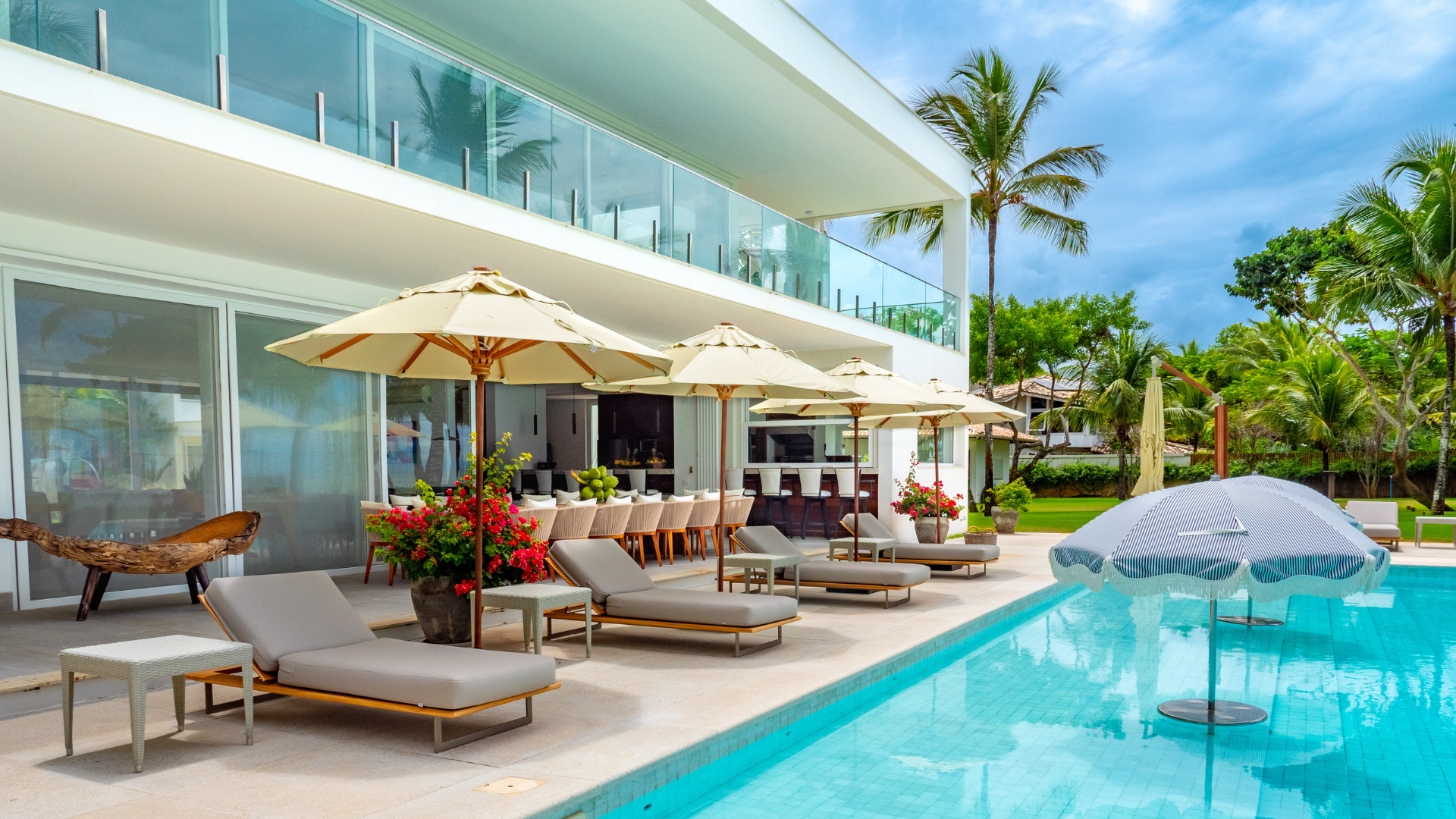
Common areas, by contrast, are wide and open. The living room transitions directly to covered terrace spaces without abrupt thresholds. Dining areas are positioned so that conversations can expand rather than compress around a single focal point.
The gallery illustrates this spatial flow clearly, particularly the way indoor volumes extend toward the ocean-facing façade.
For families with children, visibility is practical. From shaded seating areas, the pool and portions of the lawn remain within sight. Movement between interior and exterior zones does not require navigating stairs or public corridors.
Nothing feels segmented. Yet nothing feels crowded.
How the Day Actually Unfolds
In group settings, mornings begin unevenly. Someone wakes early. Someone sleeps late. Someone looks for coffee before speaking.
Because the villa opens toward the beach, early risers often step outside without crossing through communal areas. The shoreline at Araçaipe during morning low tide stretches wide, and the water remains generally calm. Walks happen without planning.
Later, breakfast expands naturally. There is no reservation time. No external table waiting. The dining area accommodates gradual gathering.
Midday divides the group. Some remain by the pool. Others move to the sand. A few may drive toward Arraial d’Ajuda’s historic center for errands or lunch. The short distance makes partial-day movement realistic, not a logistical operation. The broader context of the area is covered in the location guide, which outlines distances and nearby points of interest.
Afternoon heat draws people back under covered terraces. The architecture supports shade without enclosure. Air moves through. Curtains shift. The house adjusts without mechanical dominance.
Evenings stretch.
Because there are no adjacent guests, conversation volume does not need regulation. Dinner can move slowly without awareness of closing times. When optional chef services are arranged (outlined under experiences), they integrate into this rhythm rather than directing it.
Infrastructure That Supports Longer Stays
For extended family gatherings or multi-day celebrations, practical systems matter more than decorative elements.
A private pool reduces reliance on beach conditions. Direct sand access eliminates packing and unpacking cycles. Laundry capacity, kitchen scale, and refrigeration volume all determine whether a group remains comfortable beyond a weekend.
Housekeeping schedules are typically arranged in advance to maintain order without constant presence. The policies page generally clarifies how services are structured during longer stays.
What distinguishes a purpose-built villa from a short-term rental is not styling. It is operational smoothness when six to ten people live inside it simultaneously.
Difference from Standard Rentals or Resorts
In hotels, group travel fragments. Rooms separate across floors. Shared spaces belong to everyone and no one.
In standard vacation rentals, space may be large but acoustically exposed, or designed primarily for short turnover stays rather than sustained occupation.
At Blue Bauhaus, the scale and orientation suggest residential intent rather than rental adaptation. Storage exists where it should. Circulation paths make sense. Outdoor areas are not decorative appendages but functional extensions of living space.
The absence of shared infrastructure no lobby, no public pool, no adjacent balconies, changes the psychological atmosphere. Groups relax into private behavior more quickly.
The Role of Araçaipe Beach in Group Dynamics
Location affects cohesion.
Araçaipe Beach remains less dense than central Arraial beaches. The sandbanks widen at low tide, creating natural space between visitors. This reduces ambient noise and visual clutter.
For families, this means children can move more freely without navigating crowds. For adults, it means conversations on the terrace are accompanied primarily by ocean and wind rather than neighboring activity.
Being slightly removed from the town center does not isolate the villa. It creates buffer.
The town’s restaurants, boutiques, and church square remain reachable within minutes by car. Porto Seguro’s ferry and airport infrastructure ensure accessibility without embedding the property within high-traffic zones.
When This Type of Stay Makes Sense
Large beachfront villas in southern Bahia are often chosen for:
- Multi-generational holidays
- Small milestone gatherings
- Extended seasonal stays
- Groups combining remote work with shared time
In each case, the success of the stay depends on how well the space absorbs variation in schedule, noise, and privacy needs.
Blue Bauhaus functions well when the group values autonomy as much as proximity.
A Setting That Holds the Group Together
Over several days, the impact of geography becomes clearer.
The ferry crossing separates arrival from daily life elsewhere. The residential scale of Araçaipe reduces external stimulation. The direct beachfront orientation keeps the horizon constant.
By the end of a stay, most groups have developed their own internal rhythm. Morning walkers. Late sleepers. Afternoon swimmers. Evening lingerers.
The architecture does not dictate this rhythm. It allows it.
For visual context of layout and materials, many visitors reference the gallery prior to arrival. For logistical planning, the FAQ and policies sections clarify operational details. Broader regional context can be explored through the location guide.
The inquiry page exists for scheduling and availability, but the experience itself begins with understanding how space, privacy, and coastal geography interact over time. That interaction more than amenities or adjectives determines whether a group stay feels seamless.