

Arraial d’Ajuda does not announce itself loudly.
It unfolds gradually through light, space, and contrast.
Perched along the southern Bahia coastline, the town sits above the Atlantic on low cliffs, with beaches stretching in either direction. The atmosphere is distinct from Brazil’s more visible resort corridors. Here, luxury is less about spectacle and more about proportion: how much space you have, how easily you can step away, how naturally the day settles into rhythm.
For travelers accustomed to privacy and architectural intention, that distinction matters.
Coastal Landscape Without Density
The coastline around Arraial d’Ajuda is varied calm stretches like Araçaipe Beach, livelier pockets closer to town, and quieter expanses further south. The water tends to be swimmable, the sand wide enough for long walks without interruption.
What distinguishes the setting is not only its beauty, but its scale. Even in high season, certain areas remain comparatively uncrowded. You can swim without navigating rows of loungers. You can walk for distance without passing continuous commercial structures.
Properties positioned directly on the beach including those along Araçaipe allow guests to move between interior space and shoreline without transition zones. No elevator. No shared lobby. The ocean becomes part of the daily backdrop rather than a scheduled outing.
The location guide provides a clearer geographic overview of how beaches, town center, and access points relate spatially useful for understanding how movement here differs from more densely developed destinations.
A Town That Retains Human Scale
The historic center of Arraial d’Ajuda remains compact. Streets are navigable on foot, lined with small restaurants, independent boutiques, and galleries rather than large commercial chains.
In the early evening, the praça fills gradually. Music drifts from open windows. Lighting is warm, not theatrical. The experience feels social but not overwhelming.
For travelers who value cultural context without immersion fatigue, this balance is important. You can participate dine out, explore artisan shops, attend seasonal festivals and return to complete quiet within minutes.
There is no requirement to remain in the activity zone.
Cultural Texture Without Performance
Bahia’s identity is layered: Afro-Brazilian heritage, coastal fishing traditions, colonial influence, and contemporary Brazilian creativity. In Arraial d’Ajuda, this cultural presence feels integrated rather than staged.
Markets sell regional produce and handmade goods not curated for tourists alone. Local restaurants prepare moqueca in the traditional way slowly, in clay pots not as a decorative nod but as daily practice.
Engagement happens organically: a conversation with a shop owner, live music heard while walking between dinner and the car, an art piece discovered in a small gallery rather than a formal exhibition space.
For guests staying in private villas, this proximity to authentic culture without constant exposure to it allows for selective participation. You decide when the day includes interaction and when it returns to stillness.
Nature That Extends Beyond the Shoreline
Beyond the beaches, southern Bahia’s ecosystem includes mangroves, Atlantic forest fragments, and coastal trails. Birdlife is visible. The terrain shifts subtly from dunes to dense greenery.
Activities here are less about high-adrenaline programming and more about immersion: paddle boarding in calmer water, walking along extended coastline, visiting neighboring beaches depending on tide and time of day.
Optional recommendations and local insights typically outlined within the Experiences section serve as orientation rather than itinerary. The region rewards light structure and unhurried exploration.
Accessibility Without Exposure
Arraial d’Ajuda is reached via Porto Seguro International Airport, followed by a short transfer and ferry crossing. The arrival sequence is straightforward but distinct enough to create psychological distance from major urban centers.
That transition matters.
You are accessible flights connect through São Paulo and other hubs but once across the river, the environment shifts in tempo. Traffic diminishes. Commercial signage recedes. Vegetation becomes more prominent.
Practical considerations regarding access, transfers, and seasonal nuances are typically detailed in the FAQs and planning information, ensuring clarity without overstatement.
Why the Location Suits Private Villa Living
For travelers choosing a property such as Blue Bauhaus, the appeal of Arraial d’Ajuda lies in alignment.
The town’s scale supports privacy.
The beaches support daily ritual.
The culture supports meaningful but optional engagement.
A typical day might begin with uninterrupted shoreline, transition into a late breakfast on a shaded terrace, include an afternoon visit to town or a neighboring beach, and end in complete seclusion. The contrast between engagement and withdrawal is what defines the experience.
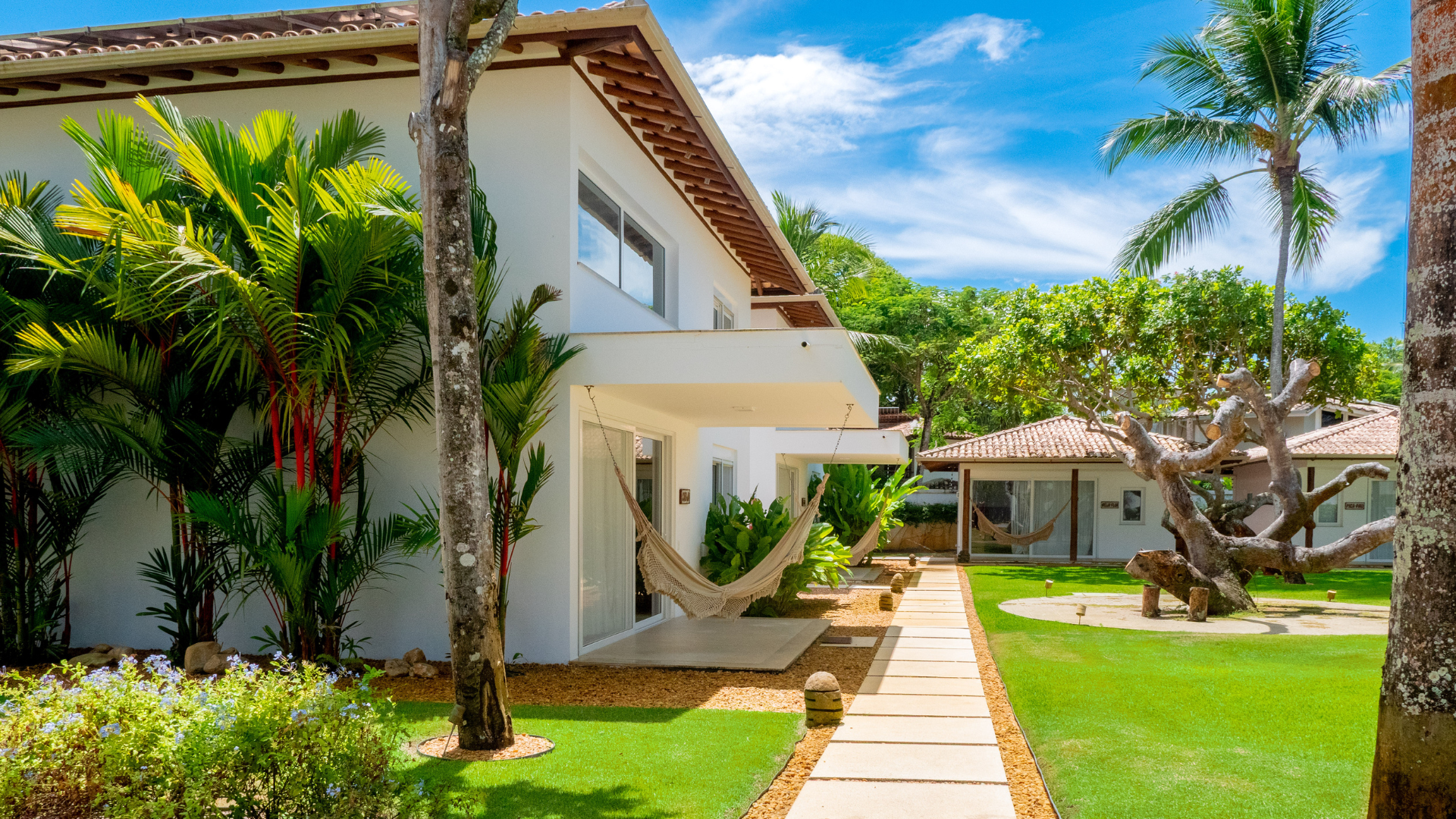
The gallery reflects how architecture in this area often responds to climate open circulation, shaded exterior living areas, and orientation toward sea breeze. These design choices only function fully in a destination that remains relatively uncompressed.
Arraial d’Ajuda still allows that spatial generosity.
A Destination for Measured Travel
Luxury travelers increasingly prioritize control over tempo. They look for destinations where privacy is structural, not marketed; where cultural engagement is possible but not imposed; where the landscape shapes the day more than programming does.
Arraial d’Ajuda meets those criteria quietly.
It does not compete with Brazil’s most publicized beach cities. Instead, it offers something more measured: a coastal town with depth, sufficient infrastructure, international accessibility, and enough restraint to let a private stay feel genuinely private.
For those who value space, discretion, and the ability to move between immersion and retreat without friction, the location itself becomes part of the design of the stay.
 English
  Portuguese