


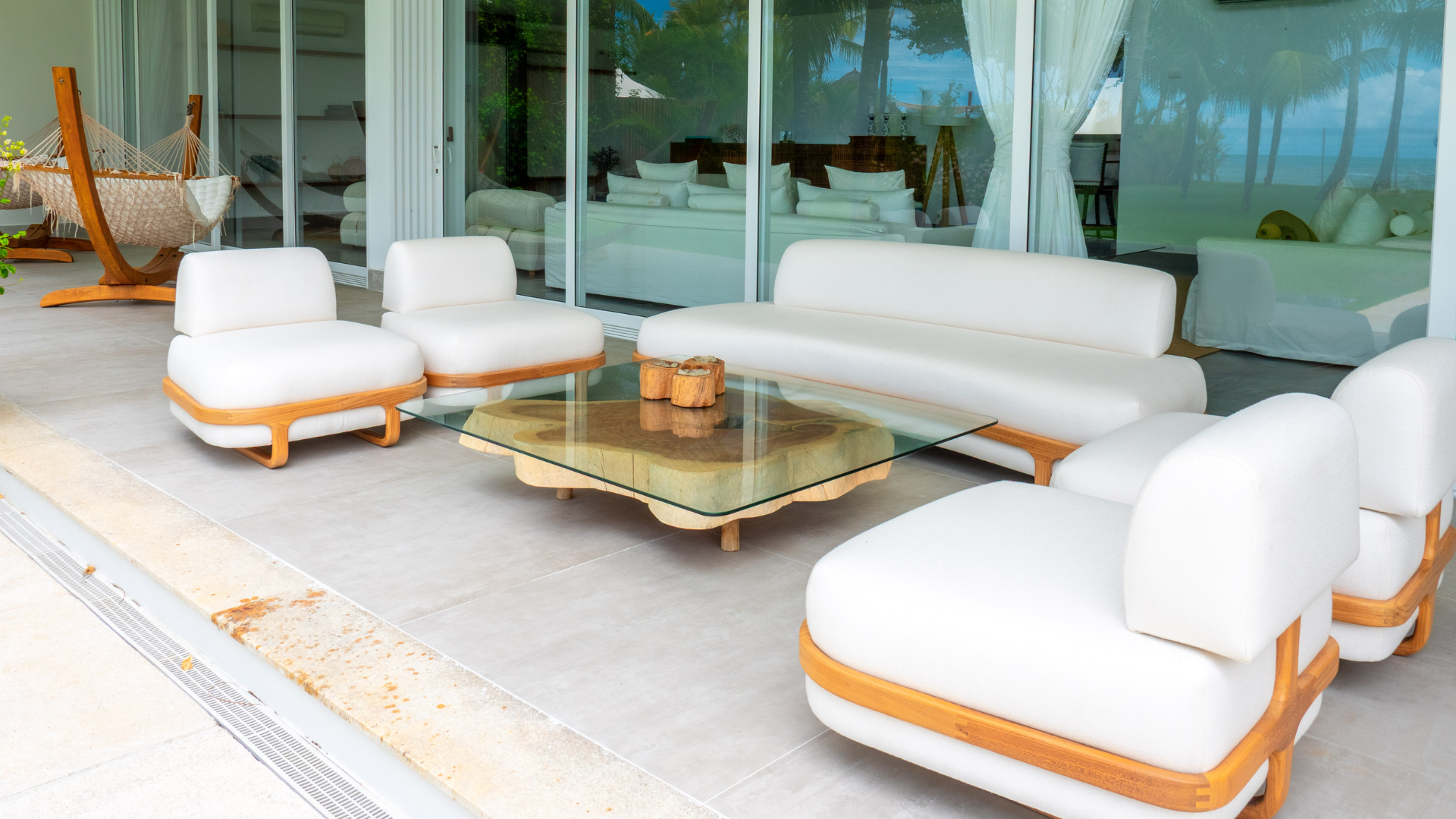
Luxury in coastal Brazil has shifted. It is no longer defined primarily by finishes or visual impact, but by how effectively a space supports autonomy, privacy, and environmental integration over multiple days.
On Araçaipe Beach in Arraial d’Ajuda, within the Porto Seguro municipality, Blue Bauhaus presents a case study in how architecture, setting, and operational structure converge to create a particular type of stay one that functions differently from both resorts and short-term rentals.
Privacy as Spatial Control
In southern Bahia, peak seasons bring density to central beach zones and town centers. Location therefore becomes the first structural decision.
Blue Bauhaus occupies a residential stretch of Araçaipe Beach, slightly removed from the commercial core of Arraial d’Ajuda. There are no shared corridors, no reception areas, and no adjacent guest balconies. Movement from bedroom to terrace to sand occurs entirely within private boundaries.
This containment alters daily behavior. Conversations do not require volume adjustment. Morning schedules diverge without logistical coordination. Shared areas remain consistently available to the same group.
Privacy, in this context, is not isolation. It is control over access and timing.
Further geographic context can be understood through the location guide, which outlines the relationship between Araçaipe, Arraial d’Ajuda, and Porto Seguro.
Architectural Orientation Toward the Coast
Contemporary coastal design in Bahia prioritizes cross-ventilation, light management, and indoor-outdoor continuity. At Blue Bauhaus, structural lines are direct and uncluttered. Large openings face the Atlantic. Covered terraces extend interior volumes toward the beach without creating visual barriers.
Natural light shifts across the living areas throughout the day. Air movement reduces reliance on fully enclosed environments. The terrace functions as transitional space neither fully interior nor fully exposed.
The gallery illustrates how circulation flows from sleeping quarters toward shared areas and outward to the pool and shoreline.
This orientation minimizes friction between daily activities. Coffee, swimming, reading, and dining occur within a continuous spatial field rather than in segmented rooms.
Supporting Multiple Travel Profiles Simultaneously
Luxury for groups depends on coexistence without compression.
Ensuite bedrooms provide acoustic and visual separation from common zones. Doors close fully. Circulation paths prevent unnecessary crossover between private and shared areas. This matters particularly for mixed compositions families with children, grandparents, couples within a larger gathering.
Communal areas are dimensioned for extended occupation. Dining tables accommodate gradual gathering rather than fixed seating cycles. Lounge areas absorb variable group sizes without forcing density.
The result is flexibility without reconfiguration. The house does not require adaptation to serve different rhythms; it is already structured to contain them.
Operational details regarding occupancy, arrangements, and house use are typically clarified in the FAQ and policies sections prior to booking.
Amenities as Functional Systems
In this category of villa, amenities operate as infrastructure rather than embellishment.
The private pool serves as an alternative to ocean conditions during tidal shifts or late afternoons. Direct beach access eliminates transitional logistics. Kitchen capacity supports multi-course meals or extended stays without repeated external provisioning.
Optional in-villa services housekeeping, chef arrangements, provisioning are typically scheduled in advance and integrated into the household rhythm. They reduce coordination demands without altering the residential character of the space.
Details on available services are usually outlined under experiences.
Relationship to Araçaipe and Arraial d’Ajuda
Araçaipe Beach sits between Porto Seguro’s ferry crossing and the historic center of Arraial d’Ajuda. This positioning creates buffer without remoteness.
The town center remains accessible within minutes by car. Restaurants, small boutiques, and the Igreja Matriz square provide evening movement when desired. Coastal trails and neighboring beaches allow for partial-day exploration without committing to long excursions.
At the same time, returning to Araçaipe restores lower density. Sandbanks widen during low tide. Ambient sound reduces to wind and water.
The villa’s placement leverages this contrast. Guests can engage the region, then disengage without distance.
Access as Part of the Experience
Arrival logistics influence perception of exclusivity.
Most guests land at Porto Seguro International Airport (BPS / SBPS), followed by a ferry crossing over the Buranhém River. The transition from airport infrastructure to coastal road marks a perceptible shift in pace.
Private aviation typically utilizes TerraVista Airport (SBTV) or Trancoso Rio Frade Airport (SJFR), with ground transfers required from all points.
This layered access flight, ferry, drive creates separation from major urban centers without compromising connectivity.
Beyond Conventional Leisure
While beachfront villas are frequently associated with vacations, their use increasingly extends to small retreats, milestone gatherings, and hybrid work-leisure stays.
The architectural clarity of Blue Bauhaus allows daytime structure meetings, workshops, shared meals without spatial conflict. At the same time, immediate beach access prevents the environment from feeling enclosed or insular.
This dual capacity differentiates purpose-built villas from adapted residential rentals.
Redefining Luxury Through Context
In southern Bahia, luxury is shaped less by ornament and more by alignment:
- Alignment between architecture and coastline
- Alignment between group size and spatial capacity
- Alignment between access and seclusion
Blue Bauhaus exemplifies this convergence.
The experience is defined not by decorative statements, but by how smoothly days unfold within its boundaries how movement feels uninterrupted, how privacy feels intact, and how the surrounding geography reinforces rather than competes with the stay.
The distinction lies in integration: when architecture, location, and operational structure function as a single system, the concept of luxury shifts from display to lived continuity.