

Family travel in coastal Brazil introduces a different set of requirements than couple-oriented or short leisure stays. Space must absorb movement. Layout must reduce risk. Proximity to nature must not compromise control.
On Araçaipe Beach in Arraial d’Ajuda, Blue Bauhaus operates within a residential stretch of coastline where density remains lower than central beach zones. The setting, combined with architectural planning, shapes how families inhabit the property over multiple days.
Safety Embedded in the Layout
In purpose-built private villas, safety is not layered on top of design; it is integrated into circulation and spatial hierarchy.
At Blue Bauhaus, outdoor areas terraces, pool, and garden zones are contained within the property perimeter. There are no shared pathways or adjacent public corridors. Access to the beach occurs directly from the grounds, eliminating road crossings or vehicular interaction.
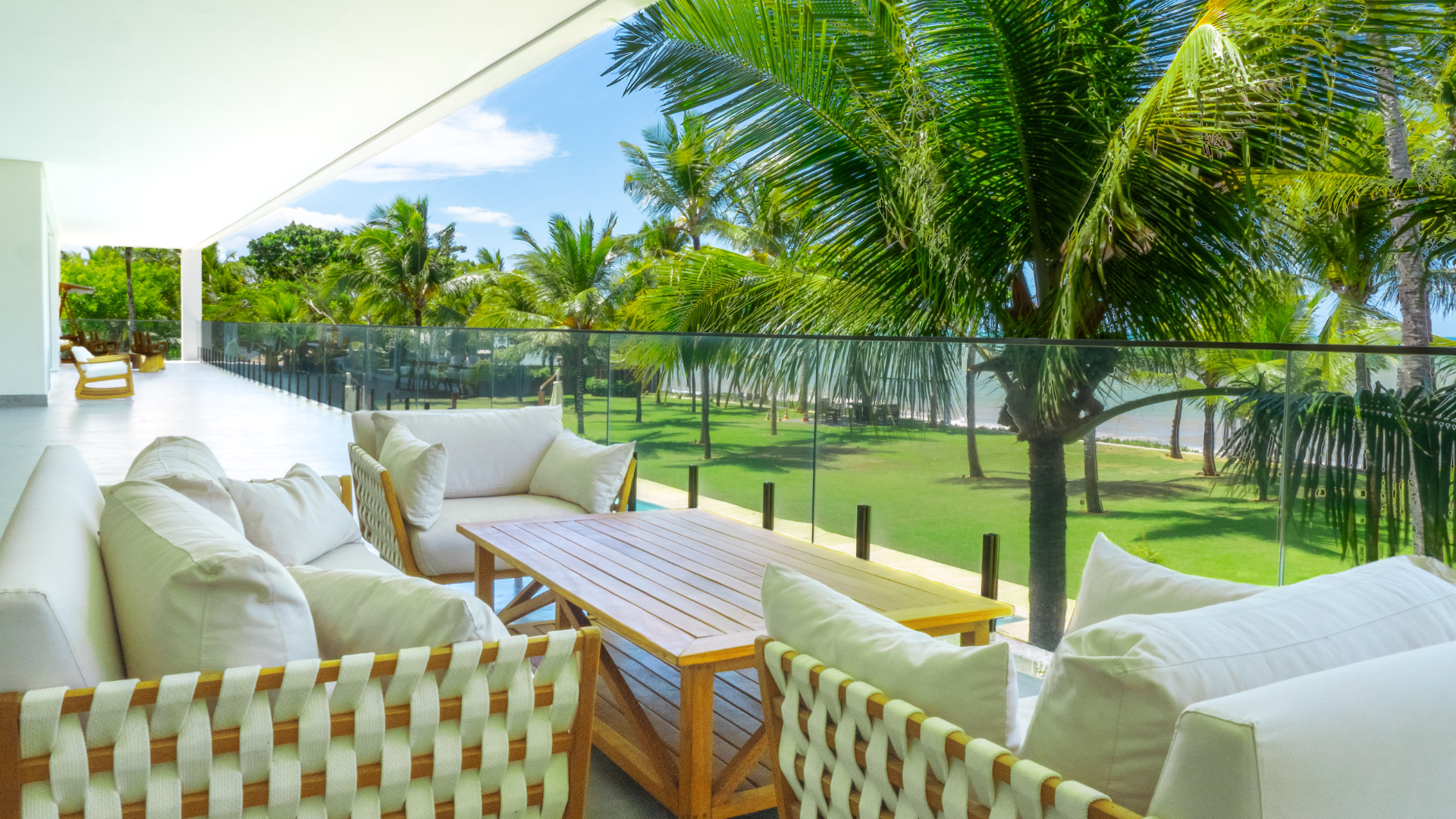
Sightlines extend across the primary outdoor spaces. From shaded seating areas, the pool and lawn remain visible. Transitions between interior and exterior zones are gradual rather than abrupt, reducing tripping points and congestion.
Staircases, thresholds, and room access points are positioned to maintain intuitive flow. Younger guests can move between spaces without navigating complex level changes, while caregivers maintain passive visual supervision rather than constant intervention.
Operational coordination, often supported by on-site or pre-arranged staff, adds another layer of structure. Housekeeping and service routines occur without disrupting the internal rhythm of the household. Practical details are generally outlined in the FAQ and policies sections for advance planning.
Spatial Structure for Multi-Generational Groups
Families rarely travel as a uniform unit. Sleep cycles vary. Noise tolerance varies. Privacy expectations vary.
The villa’s internal organization separates sleeping quarters from primary communal areas. Ensuite bedrooms provide acoustic buffering from living and dining zones. Doors close fully; corridors prevent direct sound transfer.
This separation allows grandparents to rest while children remain active outdoors. Teenagers can withdraw without isolating themselves from the group. Parents retain proximity without constant overlap.
Communal areas are scaled for shared occupation without compression. Dining tables accommodate full-family meals without rearrangement. Lounge zones absorb fluctuating group size throughout the day.
The gallery provides visual clarity on how these zones connect while remaining distinct.
Daily Function for Families
Morning routines tend to stagger. Some wake early and move directly toward the beach. Others begin indoors.
Because the villa opens toward Araçaipe Beach, early movement does not require passing through common gathering areas. The shoreline is accessible within seconds, and the residential character of this stretch reduces external activity during early hours.
Midday often centers around the pool. For families with younger children, the private pool provides a controlled aquatic environment when ocean tides shift or when closer supervision is preferred. The ocean remains an option rather than a requirement.
Afternoons transition toward shaded terraces. Covered outdoor areas allow families to remain outside without direct exposure. Air circulation reduces dependence on enclosed, climate-controlled spaces.
Evenings consolidate around shared meals. Whether self-prepared or arranged through in-villa services (outlined under experiences), dining unfolds without reservation times or external noise constraints.
The absence of neighboring guests changes behavioral patterns. Volume control becomes internal rather than externally imposed.
Supporting Different Age Groups Simultaneously
One of the defining characteristics of family-oriented villas is the ability to host parallel activity.
Indoor areas support reading, board games, film evenings, or remote study. Outdoor zones accommodate swimming, informal sports, or unstructured beach exploration.
Reliable connectivity and media infrastructure are particularly relevant for families combining travel with remote obligations. Dedicated or quiet corners allow work or study without requiring departure from the property.
This parallel capacity prevents fragmentation. Individuals can diverge in activity without diverging geographically.
Privacy Within Togetherness
Extended stays require moments of separation.
Secondary terraces and garden edges provide quieter zones for adults or older family members. Bedrooms remain insulated from active common areas. Acoustic layering ensures that rest and activity coexist.
This balance becomes increasingly important beyond short weekend stays. The architecture supports retreat without detachment.
The Role of Araçaipe Beach
Location influences family comfort more than décor.
Araçaipe Beach sits between Porto Seguro’s ferry crossing and the more central zones of Arraial d’Ajuda. This positioning maintains access while reducing density. During low tide, sandbanks widen, creating additional space between visitors.
The town center remains reachable within minutes by car. Restaurants, small shops, and the historic church square offer manageable outings that do not require full-day planning. Broader regional context is detailed in the location guide.
Returning to the villa restores lower ambient noise and visual simplicity. The coastline becomes the primary sensory reference point.
Travel and Arrival Considerations
Most families arrive via Porto Seguro International Airport (BPS / SBPS), followed by a short ferry crossing across the Buranhém River and a coastal drive south. This sequence creates perceptible separation from urban infrastructure.
Ground transportation is typically arranged in advance. For longer stays, rental vehicles allow flexible movement between beaches and town services.
Private aviation options like TerraVista Airport (SBTV) and Trancoso Rio Frade Airport (SJFR) provide additional access points within the region.
Suitability for Extended Stays
Over longer holidays, practical systems become central.
Storage capacity, kitchen scale, refrigeration volume, and laundry access determine whether families settle into routine or operate in short-stay mode. Blue Bauhaus supports the former.
Work surfaces accommodate meal preparation for larger groups. Bedrooms include adequate storage for unpacking rather than living from luggage. Circulation paths remain functional even when fully occupied.
These operational characteristics often define comfort more clearly than surface finishes.
A Structured, Low-Friction Environment
In southern Bahia, family-friendly luxury is defined by containment, clarity, and environmental integration.
Blue Bauhaus does not attempt to entertain through spectacle. Instead, it provides a controlled private environment positioned directly on a lower-density coastline, within reach of town infrastructure but removed from its congestion.
The result is a stay where supervision feels natural, movement feels intuitive, and days unfold without external scheduling pressure. The defining characteristic is not ornament, but stability spatial system that allows families to occupy the coast without negotiating it.
 English
  Portuguese